public timeline

Showing all public posts on this server. Log in to post and see your home timeline.

Matthew Sheffield @mattsheffield@mastodon.social

That's it for the thread! If you liked it, please consider following me and @discoverflux.

You can subscribe via email on Patreon here:

There's much, much more to the article actually so please read and share that as well.

Trans rights are human rights! ❤️

/end

https://www.patreon.com/cw/discoverflux

Flux — creating articles, podcasts, and community Get more from Flux on Patreon. creating articles, podcasts, and community. Support Flux and get exclusive access to their work. www.patreon.com
Matthew Sheffield @mattsheffield@mastodon.social

In fairness, while I have engaged w/ the full dataset and the popularists have not, my interpretation of it & the correlations I develop do not establish causation.

The upcoming elections will also not be definitive for either side of this debate. We need more research.

Nonetheless, I think that it's critical for trans rights advocates to have access to a complete interpretation of the data which can enable them to push back vigorously against small-bore analysis urging caving to bigotry.

Matthew Sheffield @mattsheffield@mastodon.social

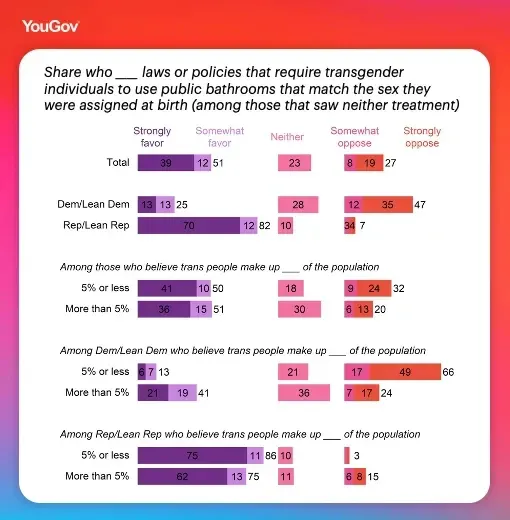
Another YouGov survey found that Democratic-leaning voters who vastly overestimated the number of trans people in America were much more likely to hold restrictive views regarding trans rights, whereas those who had more accurate views supported trans rights.

YouGov infographic showing public support and opposition to laws requiring transgender people to use public bathrooms matching their sex assigned at birth, among respondents who neither favor nor oppose transgender medical treatment. Purple bars represent support, pink represents neutrality, and red represents opposition.

Overall, 51% favor the laws, 23% are neutral, and 27% oppose them. Among Democrats and Democratic-leaning respondents, 25% favor, 28% are neutral, and 47% oppose. Among Republicans and Republican-leaning respondents, 82% favor, 10% are neutral, and 7% oppose.

The graphic also breaks down responses by beliefs about the percentage of the population that is transgender. Among Democrats who believe transgender people make up 5% or less of the population, 13% favor the laws and 66% oppose them, compared with 41% favoring and 24% opposing among those who believe the figure exceeds 5%. Among Republicans, support remains high across both groups, at 86% and 75%, respectively.
Matthew Sheffield @mattsheffield@mastodon.social

Shockingly, when experiment participants were switched back to the old chronological feed, their increased right-wing views did not disappear(!).

-----

What all of this suggests that Democrats' problem on trans issues has not been due to standing up for trans rights, it's a problem of Democrats not being able to communicate well or have anyone hear it.

And indeed, there is evidence for this.

Matthew Sheffield @mattsheffield@mastodon.social

So what is it that's causing the public to have horribly wrong views of trans rights as a policy priority for Democrats? It's right-wing media, not some annoying ads repeating far too many times on TV.

While TV ads at the presidential level have no real effect, being surrounded by far-right media does.

A study published in Nature found that people using Xitter's "For You" feed were more likely to develop policy views more similar to the Republican Party: https://www.nature.com/articles/s41586-026-10098-2

The political effects of X’s feed algorithm - Nature Among users initially on a chronological feed, 7 weeks of exposure to X’s algorithmic feed in 2023 shifted political attitudes and account-following behaviour in a more conservative direction compared with those remaining on a chronological feed, whereas switching the feed setting in the opposite direction, from algorithmic to chronological, had no effect. www.nature.com
Matthew Sheffield @mattsheffield@mastodon.social

In other words: Somehow, the public views of Democratic party and of trans rights have been grossly distorted.

Gender equality will affect almost no one, so of course it's reasonable to enact.

And while Democrats have largely supported trans equality, they absolutely have never made it a top priority.

Matthew Sheffield @mattsheffield@mastodon.social

And indeed, a November 2024 study by More in Common found that while only 9 percent of Democratic respondents listed LGBT or transgender policies as a top-three issue for them, the larger public sample believed that trans rights were Democrats' second-highest priority.

While the cost of living was far and away the top issue for Democratic voters at 40 percent, only 19 percent of the public said that it was.

Matthew Sheffield @mattsheffield@mastodon.social

All of that said, while there is no proof that supporting gender equality is harmful to Democrats by itself, it is possible that the issue is pumped up by right-wing media and candidates to make people think Democrats prioritize the issue like crazy.

Matthew Sheffield @mattsheffield@mastodon.social

Of course, the UK and US are different, but the findings are statistically significant and certainly merit duplication within the US.

Think about it: The number of people who are trans or have family members or close friends who are trans has been estimated to be between 11 and 21 percent according to PRRI and KFF.

Of course, one need not know any trans people to be a very strong ally, so the percentage of Americans who have very strong pro-trans views could be quite considerable.

Matthew Sheffield @mattsheffield@mastodon.social

Left-wing parties have little to gain by abandoning trans people, but they do have a lot to lose if they do.

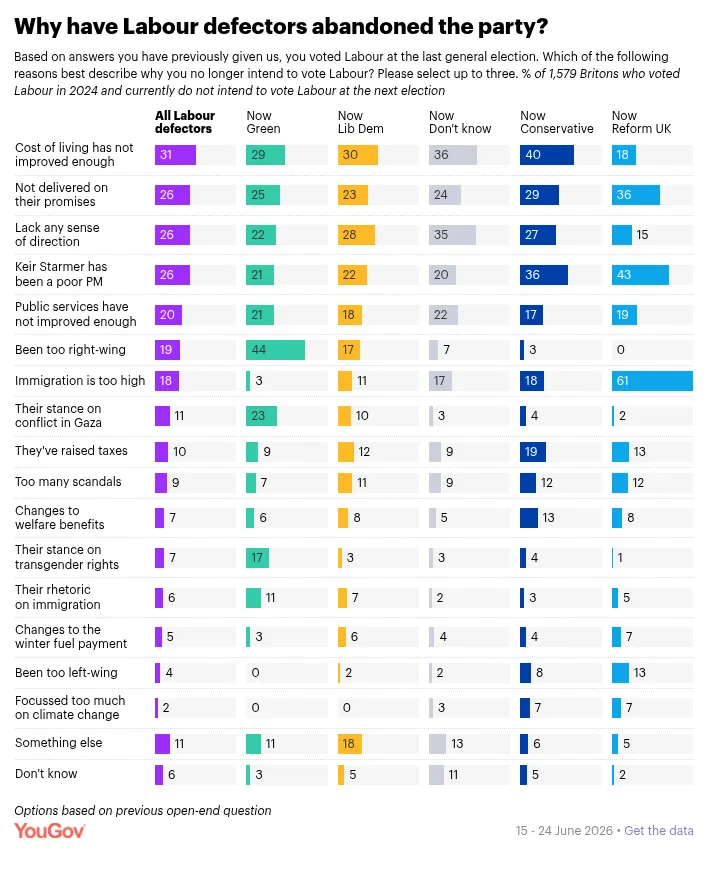
A YouGov survey conducted earlier this year in the UK found that the Labour Party lost many of its voters because it was seen as anti-trans and too right-wing.

#ukpol

A YouGov horizontal bar chart titled “Why have Labour defectors abandoned the party?” shows why people who voted Labour in the 2024 UK general election no longer intend to vote Labour at the next election. The survey asked 1,579 former Labour voters to select up to three reasons. Results are shown as percentages across six groups: all Labour defectors, those now supporting the Green Party, Liberal Democrats, Conservatives, Reform UK, and those who do not know whom they will support. Each group is represented by a different colour.

Among all Labour defectors, the most common reason is that the cost of living has not improved enough, cited by 31%. Three reasons are tied at 26%: Labour has not delivered on its promises, the party lacks a sense of direction, and Keir Starmer has been a poor prime minister. Other major concerns include insufficient improvements to public services at 20%, Labour being too right-wing at 19%, and immigration being too high at 18%.

Reasons differ substantially by voters' current political preferences. Among those now supporting the Greens, 44% say Labour has been too right-wing, 29% cite the cost of living, and 23% criticise Labour's stance on the conflict in Gaza. Among those now supporting the Liberal Democrats, the leading concerns are the cost of living at 30%, lack of direction at 28%, and broken promises at 23%. Among undecided former Labour voters, 36% cite the cost of living and 35% cite a lack of direction.

Among defectors now supporting the Conservatives, 40% cite the cost of living, 36% say Starmer has been a poor prime minister, and 29% cite unfulfilled promises. Among those now supporting Reform UK, immigration is overwhelmingly the leading concern at 61%, followed by Starmer's performance at 43% and broken promises at 36%. Reform supporters are also more likely than other groups to say Labour has been too left-wing, at 13%, while none cite Labour being too right-wing.

Less frequently cited reasons across all Labour defectors include Labour's stance on Gaza at 11%, increased taxes at 10%, scandals at 9%, changes to welfare benefits and transgender rights at 7% each, immigration rhetoric at 6%, changes to winter fuel payments at 5%, being too left-wing at 4%, and excessive focus on climate change at 2%. Another 11% select other reasons, and 6% say they do not know.

The chart illustrates a significant ideological divide among former Labour voters. Those moving towards the Greens predominantly criticise Labour from the left, while those moving towards Reform UK are particularly concerned about immigration. Dissatisfaction with the cost of living, leadership, and unfulfilled promises cuts across several groups. The survey was conducted by YouGov between 15 and 24 June 2026, with response options based on an earlier open-ended question.
Matthew Sheffield @mattsheffield@mastodon.social

Winsome Earle-Sears, the Republican running in 2025 to succeed Youngkin spent the majority of her campaign ad budget on anti-trans ads. She lost by 15 points.

In all the major races that year, anti-trans ads failed to move candidates past the finish line. They cannot save a candidate from losing.

Matthew Sheffield @mattsheffield@mastodon.social

Some political consulting organizations have claimed that they have research showing that Trump's ad campaign was effective. But they won't share their methods.

The only publicly available study with a sound methodology of the Trump ads agreed with the political science consensus: it had essentially no effect.

We've seen in subsequent elections that bashing trans people cannot protect a candidate from losing as well...

Matthew Sheffield @mattsheffield@mastodon.social

But once Youngkin won, the narrative in the political class became fixed: He did it by bashing trans people.

Believing this to be true, Republicans began making anti-trans bigotry the primary message of their campaigns.

Trump cranked up the transphobia in 2024 and once again, people credited it for his victory. In reality, most incumbents across the world were thrown out due to post-pandemic inflation:

https://www.marketplace.org/story/2024/11/14/incumbents-are-losing-around-the-world-not-just-the-u-s

无角绵羊卷 @bipolar@stelpolva.moe

不看这条都忘了自己还有一件这么厚的半天……感觉差不多是时候拿出来穿了,最近降温降得挺厉害的,一般针织衫还抗不太住。

https://moresci.sale/@bipolar/115468182213327803

无角绵羊卷 (@bipolar@moresci.sale) Attached: 1 image #闪耀卷卷 因为太冷,早上那一身到现在变成了这样(。)这个小猫半天一直很想再买件类似的,但好像没怎么看到 moresci.sale
Matthew Sheffield @mattsheffield@mastodon.social

Despite knowing all of this, however, some Democrats have gotten spooked on trans issues because they have mistaken correlation for causation.

After Glenn Youngkin won the VA governor race in 2021, the fact that he made anti-trans bigotry a key message was wrongly assumed to be causation.

The much more likely reason Youngkin won was that he was from the opposing party to the then-president, and those candidates always do much better since people often vote against rather than for parties.

Matthew Sheffield @mattsheffield@mastodon.social

The other data problem w/ abandoning trans people is that the issue itself is not important to most people.

And no wonder: People who identify as trans make up less than 1% of the population.

Before they were banned by the NCAA, there were fewer than 10 trans athletes out of more than 510,000.

Gender equality won't impact almost anyone. Cisgender people subconsciously or consciously know this.

https://plus.flux.community/p/standing-up-for-trans-people-isnt

Standing up for trans people isn’t just the right thing to do, it’s smart politics As Republicans double down on transphobia, Democrats don’t need to run away plus.flux.community
Matthew Sheffield @mattsheffield@mastodon.social

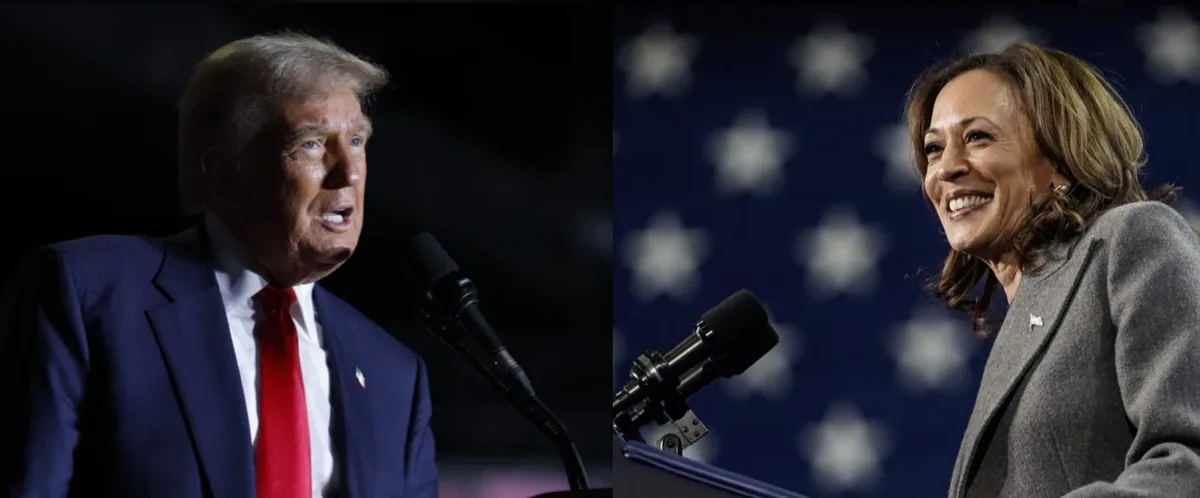
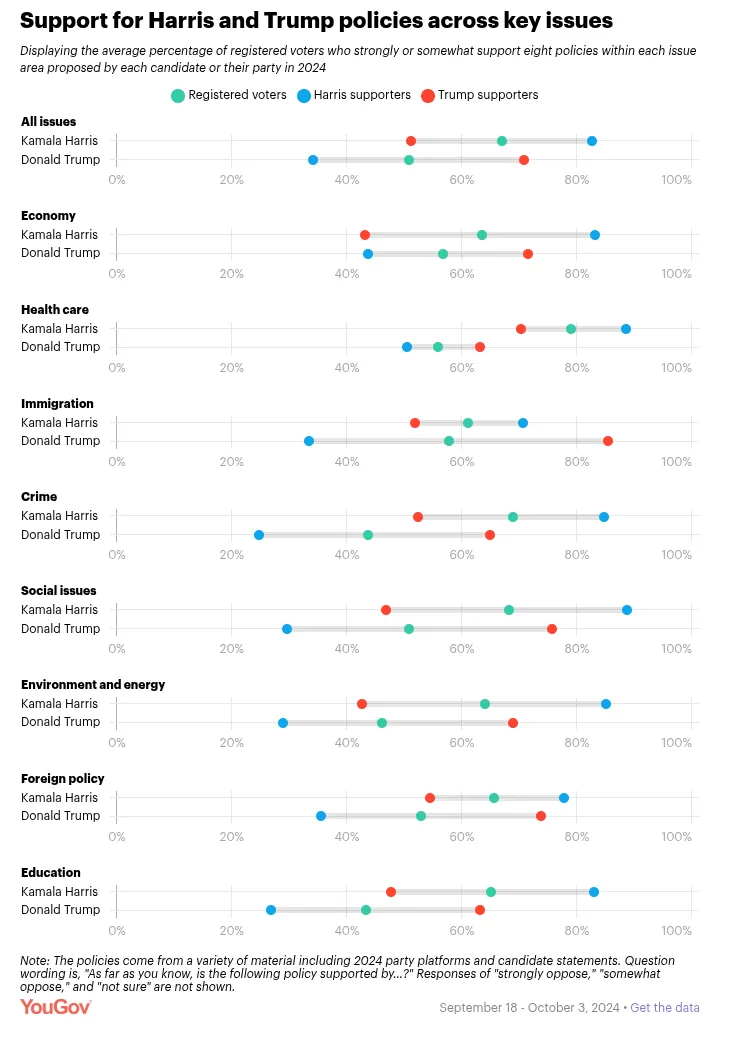
In 2024, 89% of Kamala Harris's policies were found to have majority support while only 48% of Trump's did.

On average, Trump's positions had only 51% support while Harris's had 67%.

Policies are important to some voters, but very clearly they are not to many others. Candidates changing to policies that they think are more popular will not necessarily earn them more public support.

https://yougov.com/en-us/articles/50802-harris-vs-trump-on-the-issues-whose-policies-do-voters-prefer

Harris vs. Trump on the issues: Whose policies do voters prefer? As the 2024 presidential election approaches, we take a deep dive into the policies that registered voters support, the issues they care about, and the candidates they trust to handle them. yougov.com
A complex graph showing a 2024-based comparison of the policies of Donald Trump and Kamala Harris.

Across nearly all issues, policies backed by Harris and the Democratic Party are, on average, more popular than those backed by Trump and the Republican Party. 89% (57 out of the 64) of Harris' policies included in the survey are supported by more than half of voters. The same is true for just 48% (31 of 64) of Trump's policies.
Harris' policies are more likely than Trump's to be supported by voters overall (67% average support for Harris' vs. 51% for Trump's).
Her proposals also are more popular among her supporters (83% average support) than Trump's are among his (71%).
Trump's supporters are more favorable towards Harris' policies (51% support) than Harris' are towards Trump's policies (34%).
53% of Harris' policies and 19% of Trump's policies are bipartisan, which we define as being strongly or somewhat supported by more than 50% of Democrats and also by more than 50% of Republicans (a recent YouGov project found 109 national policies with bipartisan support).
Harris' policies excels most relative to Trump's on health care and social issues.
Many of Harris' health care policies receive bipartisan support, including increasing in-home care funding, investigating anti-competitive behavior by pharmaceutical companies, and expanding Medicare drug price negotiations.
Allowing more refugees to enter the U.S. is Harris' least popular policy, and her second least popular is increasing the royalties that oil and gas companies are charged to drill or mine on public lands.
Harris' proposals to expand birth control access and establish paid family leave are favored by majorities of her own supporters and Trump's. A majority of voters also support her plan to restore abortion rights nationally as they were under Roe v. Wade, though views on this are more polarized.
Trump's strengths with voters generally lie in policies related to the economy and immigration. Even in these areas, though, Trump's specific policies are on average no more popular than Harris'.
Large shares are in favor of Trump's proposals to eliminate taxes on Social Security income and to use the Alien Enemies Act to deport certain immigrants.
Among Trump's least popular policies are deregulating cryptocurrency, reducing automobile fuel-efficiency standards, and eliminating the U.S. Department of Education.
Trump's proposals on crime also are among his least supported: Few favor allowing the death penalty for drug dealers, giving qualified immunity to police officers, or pardoning participants in the January 6, 2021 attack on the U.S. Capitol.

older